
Your plant can ship more. It needs one pace.
Kuvia maps how your line really flows, paces it from one point, puts buffer inventory where work waits, and trains your people to keep it running.
- Set up from your own data
- Works with your business system
- Your data stays yours
| Order | Due | Time used | Status |
|---|---|---|---|
| A-1042 | Mon | 92% of time used | Act today |
| A-1047 | Tue | 71% of time used | Watch |
| A-1051 | Tue | 58% of time used | Watch |
| A-1055 | Wed | 34% of time used | On track |
| A-1058 | Thu | 22% of time used | On track |
| A-1060 | Fri | 9% of time used | On track |
Sound familiar?
It’s rarely the people. It’s one step setting the pace — and a schedule that ignores it.
Built from work across
- Metal fabrication
- Industrial equipment
- Medical devices
- Hydraulics
- Food & beverage
- Consumer products
- Plastics & packaging
- Semiconductors
- Aerospace
- Process & refining
- Distribution
If two or more of these sound familiar, we should talk.
Production scheduling paced from one point works best in make-to-order and high-mix plants.
- Orders ship late while some machines sit idle
- Expediting decides what runs next
- Work in process piles up between steps
- Overtime is the plan, not the exception
- Your business system’s schedule and the floor rarely agree
From order to shipment, in one system.
Your production schedule runs the full cycle at one pace — not just the next shift.
- PlanSchedule set at the pacemaker
- ReleaseWork released only when it’s complete and needed
- RunProgress at every step, in quantities
- ProtectBuffers flag what needs help today
- DeliverOn-time delivery, week by week
A schedule the floor can actually follow.
Release, buffers and delivery — all from your plant’s own data.
| Order | Kit | Action |
|---|---|---|
| A-1063 | Ready | Release Mon |
| A-1064 | Ready | Release Mon |
| A-1066 | Missing material | Hold |
| A-1067 | Ready | Release Tue |
| A-1070 | Waiting on drawing | Hold |
The fix is simple.
Pace the whole line from one point, hold buffer inventory where work waits, and start work only when it can flow.
- 1Map the flowWhere work waits, and why.
- 2Choose the pacemakerOne point the schedule is set at.
- 3Buffer and releaseStock where work waits; start only what can flow.
Work piles up everywhere. Orders get later.
Work waits in one place. Orders flow.
Illustration, not plant data.
A better schedule, plus the people to make it stick.
Inventory where work waits, and nowhere else.
Too much stock ties up cash; too little stops the line. We size it around the flow.
- Inventory buffers with minimum and maximum levels
- Replenishment tied to what is actually used
- Late supplier parts flagged before they stop the line
- Work released only when its kit is complete
A proven playbook, not a blank page.
Every implementation follows the same sequence, adapted to your plant.
- Weeks 1–2See it
Floor walk, your data loaded, the value stream mapped and the pacemaker chosen.
- Weeks 3–4Set it up
The schedule set up on your plant, buffer inventory positioned and sized, schedulers and supervisors trained.
- Weeks 5–6Go live
The schedule runs on the floor and the daily buffer meeting starts.
- Months 2–4Make it stick
Coaching until your team runs it. Results tracked against day one.
Lessons built into every rollout.
Stabilise before you optimise
If the floor runs on expediting, the first job is stability. Change an unstable system and you can’t tell what worked.
The floor’s answer wins
When the system’s routings disagree with what actually happens, we fix the data — not the people.
A short daily meeting beats a monthly review
Reds discussed every morning, with an owner and a date, is what keeps the gains.
Before you ask.
What do we get?
A scheduling board set up from your own data, a trained scheduler and supervisors, and a short daily meeting that keeps it running.
How long until the schedule is running?
The new schedule goes live on your floor in the six-week Sprint. Coaching continues until your team runs it without us.
Do we have to replace our business system?
No. The schedule is built from the report exports of the system you already have.
What do you need from us?
Leadership behind it, access to your data, and time from your scheduler and supervisors.
What if our data is messy?
It usually is. Part of the work is finding where routings don’t match the floor, and fixing that first.
Who owns the schedule once you leave?
Your team. The scheduler builds it and your supervisors run the daily meeting.
Is our data kept confidential?
Yes. Your data stays in your setup, and we never name clients.
Roll the dice. Push, then pull.
An eight-station production line run with dice. See what pacing the line from one point and placing buffers where work waits does to output, lead time and cash.
Play the dice game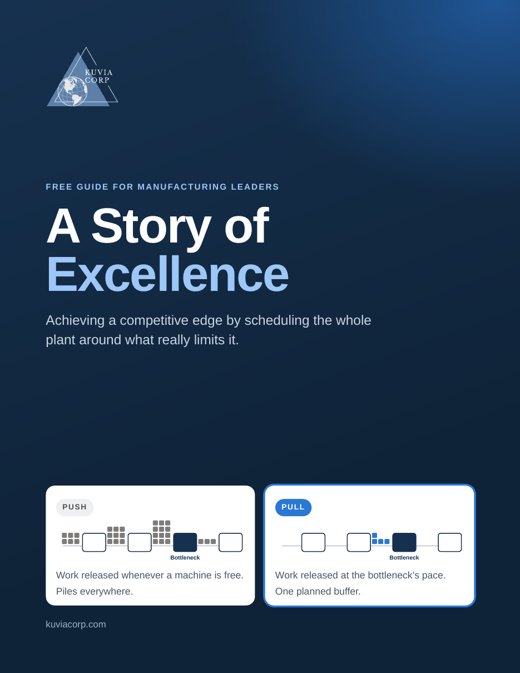
A Story of Excellence
How manufacturers get a competitive edge by scheduling the whole plant around what really limits it. Ten pages, free.
Get the free guideSee it on a plan like yours.
Tell us about your plant. We’ll show you how your line could be paced, and say whether it fits.